

icon-feather-calendar 19th November 2024

Celebrating Women in Leadership – Vyman Solicitors “Breaking the Glass Ceiling” Event

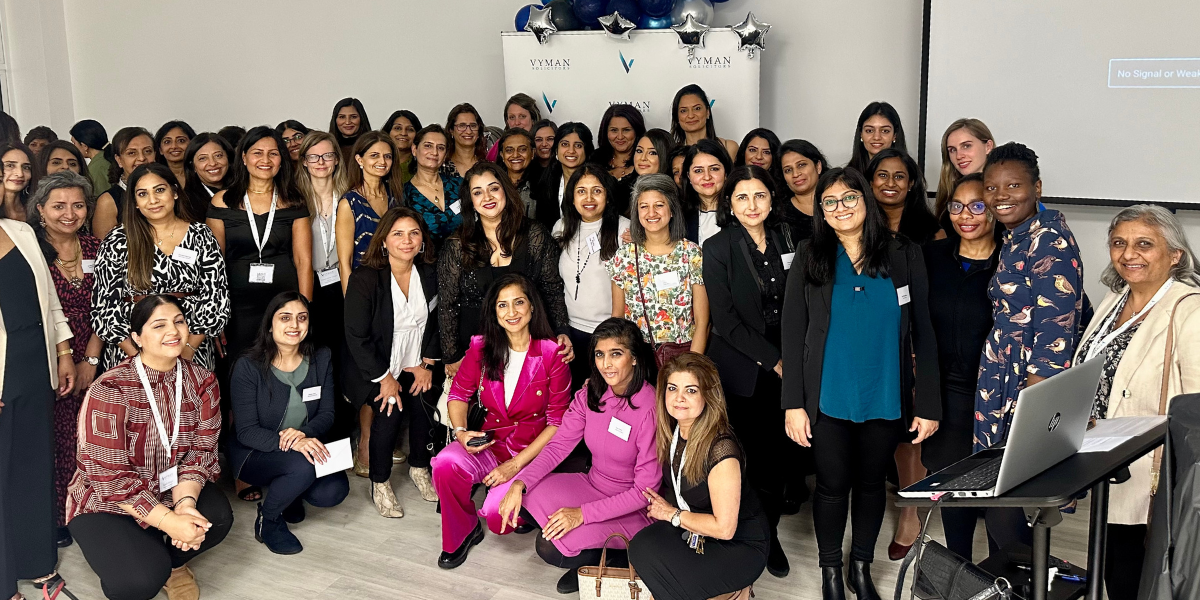
On 24th October 2024, Vyman Solicitors proudly hosted the highly successful “Breaking the Glass Ceiling” event in Harrow, North West London. Dedicated to empowering Women in Business and Senior Leadership roles, the evening brought together an inspiring network of women leaders from diverse industries for meaningful conversations, networking, and motivation.

The event featured moving talks by distinguished speakers, including Paven Kaur, Dr Rasha Gadelrab, and Shilpa Chedda, who each shared unique insights from their journeys across fields from Finance, Healthcare, Fashion and Business. Their stories of resilience and triumph over life and workplace challenges provided a meaningful platform for attendees to exchange experiences and inspire one another.

Zharna Sutaria, Head of Vyman’s Family Law Department, reflected on the evening, saying, “This event is a testament to the strength and determination of women who continually strive to surpass the boundaries set before them. Bringing together so many talented women reminded us all of the power of community and collaboration.”

Sheetal Badiani, Head of Vyman’s Commercial Law Department, added, “It’s an honour to host an event that resonates with our values of inclusion and ambition. Breaking the glass ceiling isn’t just about personal success; it’s about lifting each other up and building a support network that drives all of us forward.”

The event was a true celebration of leadership, ambition and the power of women supporting women. From networking opportunities to moving discussions, attendees left the event feeling empowered and motivated to continue breaking barriers in their respective fields.

Vyman Solicitors remains committed to creating inclusive spaces that empower individuals and strengthen communities. Building on the success of this event, we look forward to hosting more initiatives that inspire and connect women in business and leadership roles.

Follow Us and Stay Connected
To relive the memorable moments from the evening, be sure to follow Vyman Solicitors on LinkedIn, Instagram, and Facebook, where we’ll be sharing highlights, reflections, and photos.

Thank you to everyone who joined us and made the evening so special. Stay tuned for news of future events—we look forward to welcoming you again!

About Vyman Solicitors
Based in Harrow, North West London, Vyman Solicitors is a trusted legal partner offering comprehensive services across Corporate and Commercial Law, Litigation, Residential Property, Family Law, and Private Client matters. Known for its client-focused approach and commitment to excellence, Vyman continues to support businesses and individuals through life’s critical moments.

For further information or to register your interest in future events, please contact us at info@vyman.co.uk.


icon-feather-calendar 13th November 2024

Top Tips from Our Trainee Solicitors for Aspiring Paralegals at Vyman Solicitors

If you are ready to embark on a career in law and are considering a Paralegal role at Vyman Solicitors, our Trainee Solicitors are here to help! They’ve shared their top five tips to give you an edge and help you prepare for a successful application. Here is what they recommend for anyone hoping to join our team at Vyman Solicitors based in North West London.

1. Showcase Your Commitment to Law

Your passion for a legal career is crucial to standing out as a candidate. Highlight any past experience, internships, or volunteer roles that demonstrate your dedication to the field. When discussing your experience, focus on areas relevant to our core practice areas, such as Commercial, Property Law, Litigation, Residential, Conveyancing, Family Law, Private Client and Immigration. Showing genuine interest in these areas adds weight to your application and makes it more memorable.

2. Research Vyman Solicitors’ Values and Specialisations

At Vyman Solicitors, we take pride in our core values and our commitment to excellence in client care. Our firm covers diverse legal sectors, and understanding this breadth demonstrates that you have done your homework and are genuinely interested in what we do. Tailor your application to reflect how your career aspirations align with Vyman’s mission and values. This attention to detail shows that you’re not only enthusiastic about the role but that you’re invested in joining our team specifically.

3. Highlight Practical Skills and Attention to Detail

Being a successful Paralegal requires exceptional organisational skills and a sharp eye for detail. Paralegals are essential in managing multiple cases and ensuring that administrative tasks are handled efficiently. Emphasise any experience where you demonstrated these qualities, whether it was organising projects, managing tasks or assisting with documentation in a previous role. Examples of your practical skills can set you apart and illustrate your readiness for the role.

4. Emphasise Strong Communication Skills

Strong interpersonal and communication skills are key, especially when working directly with clients and supporting solicitors. Highlight examples of when you communicated complex information effectively, whether in professional, volunteer or academic settings. Demonstrating how you have built strong relationships and resolved issues shows that you’re ready to thrive in a client-centred role like this.

5. Prepare to Demonstrate Adaptability and Resilience

The fast-paced environment of a law firm requires resilience and the ability to adapt to evolving challenges. Show that you’re capable of staying calm under pressure, handling multiple tasks, and adjusting to new priorities. Adaptability is crucial for success as a Paralegal at Vyman Solicitors, so share examples of times you rose to the occasion in demanding situations.

Our Trainee Solicitors have walked this path themselves, and their insights can help you prepare an outstanding application. Good luck, and we look forward to hearing from you at Vyman Solicitors!

Ready to apply? Send your CV and cover letter to recruitment@vyman.co.uk and take the next step towards an exciting legal career. Please note our criteria to apply.

Vyman Solicitors are conveniently located in North West London, making it ideal for anyone commuting from Central London or the surrounding areas of Buckinghamshire, Berkshire, and Hertfordshire. With direct access to the Metropolitan Line, our location attracts a diverse team of Paralegals and Solicitors from across the region, allowing for a dynamic and well-connected working environment.

icon-feather-calendar 1st November 2024

No-Fault Divorce: Does It Mean More ‘I Do’ or ‘I Don’t’?

The biggest shakeup in divorce law in over 50 years came with the introduction of no-fault divorce in April 2022. This significant change removed the need to assign blame for the breakdown of a marriage, a long-standing source of conflict between spouses. Before this change, many divorces were framed as a “blame game,” with one spouse often seeking to place full responsibility on the other. But as we all know, it takes two to tango, and divorce is rarely the fault of just one person.

With the introduction of no-fault divorce, the aim was to reduce animosity and conflict, not just between spouses, but also to protect the children caught in the middle. The idea was simple: remove the need to assign blame and foster a more amicable separation. The Ministry of Justice had predicted that the number of divorce applications would rise as a result of this change. However, the statistics tell a different story.

Key Statistics Since No-Fault Divorce

  • 28,865 divorce applications were made between January and March 2024.
  • 76% of these were sole applications; only 24% were joint applications.
  • This represented a 5% decrease in applications compared to the same period in 2022 under the old law.
  • Divorce filings have decreased by 29.5% overall since 2022.
  • There was a 19% drop in financial remedy applications between October and December 2023.

What Do These Numbers Mean?

One of the most surprising findings is the decline in divorce filings after the no-fault law was introduced. Contrary to expectations, the new process has not led to an increase in applications. The breakdown between sole and joint applications is also notable: three-quarters of applications are sole applications. This suggests that in many cases, one spouse is still more eager to proceed with the divorce than the other. Under the old law, a spouse could contest the divorce if they disagreed with the grounds cited. However, with the new system, there is no option to contest a divorce unless there are jurisdictional issues, which are rare.

The new system has also created a more collaborative environment for divorcing couples. Previously, the attribution of blame set an acrimonious tone right from the start, making it difficult for couples to agree on key issues such as children and finances. Now, with no-fault divorce, both parties can reach a mutual decision to end the marriage and focus on resolving their issues amicably.

This trend towards cooperation is also supported by the requirement introduced in April 2024 that couples engage in Non-Court Dispute Resolution (NCDR) before filing for financial remedy proceedings. Legal experts have found that this has helped reduce animosity at the outset, making it easier to settle matters without court intervention.

Challenges in the New Divorce Landscape

Despite the positives, there are some challenges with the new no-fault system. The introduction of a 20-week cooling-off period has extended the divorce process, with the average time from application to final order now standing at 65 weeks. This extended timeline has led some couples to seek faster alternatives, such as separation agreements, especially if they are unsure about fully committing to divorce proceedings.

The other big factor influencing divorce rates is cost. With the current economic climate and the cost of living crisis, many couples have found that divorce is simply too expensive right now. As a result, some are choosing to postpone their divorces or explore alternative arrangements.

Interestingly, the online divorce process has made it easier for couples to manage their own divorces without legal representation, reducing the need for solicitors. This shift has helped couples save on costs, but it has also led to a decrease in financial remedy applications—as couples are more willing to negotiate financial agreements between themselves rather than pursuing contested proceedings.

Why You Still Need Legal Guidance

While many couples are successfully navigating the new system without legal help, it’s crucial to remember that any financial agreement reached during a divorce must be formalised in a Consent Order to be legally binding. Without this, your ex-spouse could potentially make a financial claim against you in the future, especially if your financial circumstances change.

If you’re going through a divorce or separation, or if you need help formalising a financial agreement, our expert team at Vyman Solicitors is here to guide you. Whether you’re dealing with no-fault divorce, financial remedy proceedings, or need assistance drafting a Consent Order, we can help you navigate this process smoothly.

by Minoli Vehella

Trainee Solicitor I Family Law 

Get in Touch

For assistance with no-fault divorce, financial remedy proceedings, or formalising financial agreements, contact the Family Law team at Vyman Solicitors on 020 8427 9080.

We’re here to support you every step of the way.

icon-feather-calendar 1st November 2024

Goodman v Walker: A Simple Guide to Transparency in the Family Court

In 2021, the Family Court took steps towards greater openness with the report Confidence and Confidentiality: Transparency in the Family Court. This report aimed to make the court more transparent while still protecting the privacy of those involved in family disputes. One major change from this report was the introduction of the Family Court Reporting Pilot.

What Is the Family Court Reporting Pilot?

Introduced in January 2023 in cities like Cardiff, Leeds, and Carlisle, this pilot allowed accredited journalists and legal bloggers to attend and report on family court cases. The goal was to help the public better understand how family courts work while still protecting the identities of those involved, particularly children. By January 2024, the pilot expanded to cover more courts, including the Central Family Court in London.

What Is a Transparency Order?

While the reporting pilot aims to increase openness, the Family Court still has the power to issue Transparency Orders. These orders protect the privacy of individuals by preventing the release of information that could identify children or families involved in a case. The court can issue such an order based on its own judgment or upon request from one of the parties. The goal is to protect privacy where needed, with each case being assessed individually.

The Case of Goodman v Walker

In a recent case, Goodman v Walker, involving well-known celebrities, the court had to decide whether privacy or transparency should take priority. Typically, the court protects the identities of children involved in cases like this, but Judge Hess chose to publish his judgment without hiding the names of the parties or their children.

Why did this happen? Judge Hess argued that since the individuals had already shared many details of their dispute with the public, any potential harm to their children had already been done. He believed it was more transparent to publish the full judgment without redactions, allowing the public to form their own opinions.

What Does This Mean for Family Court Transparency?

The Goodman v Walker case is an exception, not the rule. In most cases, especially those involving children, the court will continue to prioritise privacy and issue Transparency Orders when necessary. However, this case shows that in certain high-profile situations, the court may choose a more open approach.

Balancing transparency and privacy in the Family Court is complex and evolving. While Goodman v Walker was an unusual case, it highlights how the court can make different decisions based on the unique circumstances of each case. At Vyman Solicitors, we are here to help you navigate family law with sensitivity and expertise, ensuring your privacy is protected throughout the process.

By Tanya Patel Trainee Solicitor I Family Law

Sources